diophantine.cpp File Reference
module diophantine
Primary module interface unit for module diophantine. More...
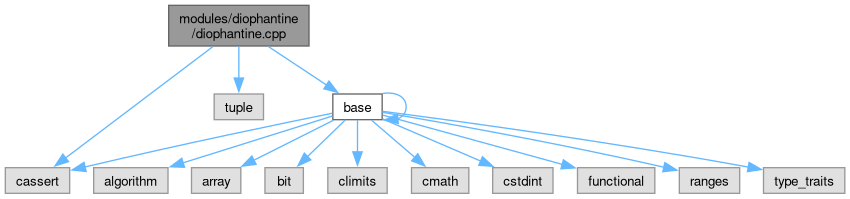
Include dependency graph for diophantine.cpp:
Functions | |
| template<Integer T> | |
| constexpr T | ntlib::diophantine_linear_univariate (T a, T b) noexcept |
| Compute integer solutions to linear univariate diophantine equations. | |
| template<Integer T> | |
| constexpr std::tuple< T, T, T > | ntlib::diophantine_linear_bivariate (T a, T b, T c) noexcept |
| Computes integer solutions to linear bivariate diophantine equations. | |
Detailed Description
Primary module interface unit for module diophantine.
Function Documentation
◆ diophantine_linear_bivariate()
template<Integer T>
|
nodiscardconstexprexportnoexcept |
Computes integer solutions to linear bivariate diophantine equations.
Computes an integer solution \((x,y)\) to the diophantine equation \(ax + by = c\). A solution exists if and only if \(c\) is a multiple of \(\mathrm{gcd}(a,b)\). In this case, there are infinitely many solutions.
- Template Parameters
-
T An integer-like type.
- Parameters
-
a The coefficient of \(x\). b The coefficient of \(y\). c The absolute offset. Must be a multiple of \(\mathrm{gcd}(a,b)\).
- Returns
- A triple with \(x\), \(y\) and \(\mathrm{gcd}(a,b)\) where the latter can be used to compute other solutions using via Bezout's Identity. In case \(a = b = 0\), the third element is \(0\).
◆ diophantine_linear_univariate()
template<Integer T>
|
nodiscardconstexprexportnoexcept |
Compute integer solutions to linear univariate diophantine equations.
Computes an integer solution in \(x\) to the diophantine equation \(ax = b\). A solution exists if and only if \(b\) is a multiple of \(a\). For \(a = b = 0\) each \(x \in \mathbb{Z}\) is a solution and \(x = 0\) is returned. In all other cases the solution is unique.
- Template Parameters
-
T An integer-like type.
- Parameters
-
a The coefficient of \(x\). b The absolute offset. Must be a multiple of \(a\).
- Returns
- The solution in \(x\).
Generated by
 1.16.1